
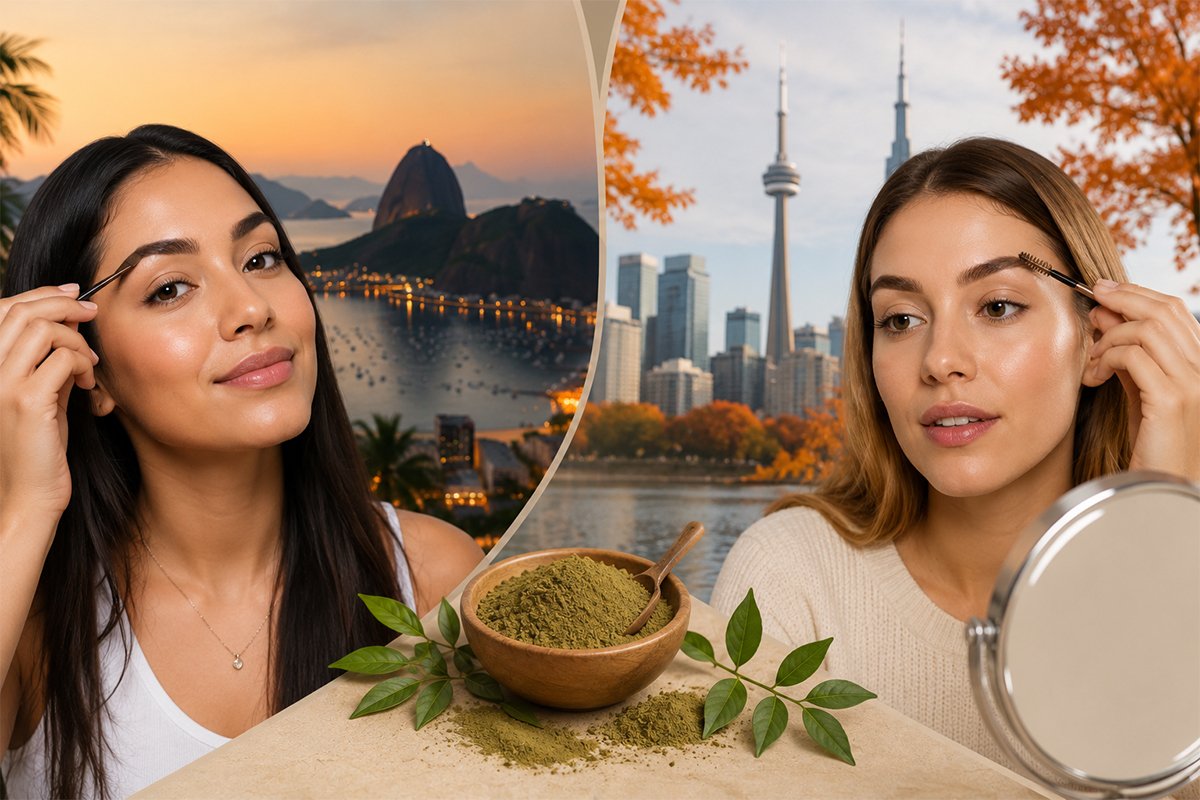
How Eyebrow Henna Is Evolving Differently in Brazil and Canada
Eyebrow henna is splitting into two distinct product categories depending on which market it’s formulated for. In Brazil, salons push for fast-setting, high-pigment formulas that stain skin deeply for bold, ombré-style brows built for high-volume brow bars. In Canada, demand runs the opposite direction: soft, natural-looking tint, custom undertone blending, and clean-label, hypoallergenic eyebrow henna free from PPD, ammonia, and animal-derived ingredients. For eyebrow henna manufacturers, exporters, and wholesale suppliers, this means one formula cannot serve both markets — pigment strength, dwell time, and ingredient transparency each need a different playbook.
Most articles on this topic stop at “henna is natural, tint is chemical.” That’s not enough for anyone actually sourcing product or running a brow business. Below is the market-level breakdown: what’s actually changing in Brazilian and Canadian brow services, why the regulatory environment in each country is quietly steering formulation decisions, and how brands and salons should respond.
1. Eyebrow Henna Trends in Brazil
Brazil runs one of the busiest brow-service markets in Latin America, driven by shopping-mall brow bars, high client turnover, and a beauty culture that treats brow definition as a near-daily maintenance category rather than an occasional treatment. That volume shapes everything about how eyebrow henna is formulated and sold there.
Fast-Setting Henna and Salon Efficiency
Brazilian brow studios typically book clients back-to-back, so dwell time is a business metric, not just a comfort factor.
- Standard eyebrow henna needs roughly 20–40 minutes of processing time to fully bond with keratin in the skin and hair. Brazilian-market formulas are increasingly built to cut that window down through warmer-activating cream-gel bases and higher lawsone concentration, the plant compound responsible for the actual stain.
- Faster-setting formulas let a single technician run more chairs per shift — a direct margin driver for brow bars operating on volume rather than premium single-client pricing.
- Speed is marketed as a feature on product packaging and salon menus alike, which is different from most Western markets, where “natural” or “gentle” claims dominate the shelf.
Hybrid Skin Staining and Ombré Brow Effects
Brazilian consumers generally want the skin stain, not just the hair color. That’s the entire point of choosing eyebrow henna over a standard eyebrow dye.
- “Hybrid” application — henna at the root and tail blended with a slightly lighter mid-brow tone — has become a standard technique for the ombré brow look, replicating the shading effect of microblading without needles.
- Because Brazil’s population spans an unusually wide range of skin undertones, manufacturers serving this market carry broader shade libraries than most — typically splitting into red-based, ash, and neutral bases so the stain reads correctly on both fair and deep skin tones rather than shifting orange or grey.
- Humidity and higher average perspiration rates also push formulators toward stains with stronger sweat and water resistance, since a brow bar client isn’t returning three days later for a touch-up.
Brow Formulas With Care Ingredients for Fuller-Looking Brows
Brazilian eyebrow henna increasingly bundles conditioning actives into the stain itself rather than selling them as a separate step.
- Castor oil, biotin, panthenol, and peptide blends are commonly added to support hair growth and thickness, since a large share of the client base is trying to build brow density rather than simply add color to already-full brows.
- There’s a regulatory dimension behind this trend that most content on the topic misses: under Brazil’s ANVISA framework (Resolution RDC 907/2024), hair-dyeing and hair-coloring products — including henna that alters hair color — fall into the Grade 2 risk category, which requires full registration, documented proof of safety and effectiveness, and a ten-year authorization cycle, not just a simple notification. Once a manufacturer has already invested in that registration and stability testing, adding higher-potency actives and visible “fuller-looking brow” performance becomes the natural way to justify the product’s position on the shelf.
- Labels sold in Brazil must appear in Portuguese and carry the mandatory hair-dye caution statement required by ANVISA, which shapes how far a foreign exporter can simply relabel a global formula versus needing a market-specific version.
2. Eyebrow Henna Trends in Canada
Canada’s brow market runs on a different set of pressures: a highly multicultural client base with a wide spread of natural hair colors, a colder and drier climate that removes the “sweat resistance” problem, and one of the more assertive clean-beauty retail cultures in North America.
Soft, Feathered, Natural-Looking Henna Brows
The dominant aesthetic in Canadian brow studios right now is “your brows, but better” rather than a visibly drawn-on shape.
- Technicians commonly dilute the henna paste and shorten dwell time specifically to soften the skin stain, aiming for a shadow rather than a solid block of color.
- Feathered, hair-stroke application under a light lamination has become a common combination service — henna adds color depth while lamination sets the hair pattern, producing a groomed-but-undone look.
- This is a meaningfully different technique from Brazil’s approach: the goal isn’t maximum stain retention, it’s a stain subtle enough that regrowth and fading don’t create an obvious two-tone brow.
Custom Undertone Mixing for Better Color Matching
Undertone mixing is a bigger deal in Canada than in most henna markets, and the reason is demographic, not aesthetic preference alone.
- Canadian clientele includes a much wider spread of natural hair colors — blonde, red, grey, and salt-and-pepper brows are common alongside dark brown and black — so a single “brown” eyebrow henna shade doesn’t work for the client base the way it can in markets with more uniform hair coloring.
- Technicians are trained to blend two or more base tones (typically ash, neutral, and warm/chestnut) at the point of service to match both the client’s hair color and skin undertone, rather than selecting a single pre-mixed shade off a shelf.
- This has pushed eyebrow henna manufacturers serving Canada to sell mixable base systems and shade-matching guides rather than a fixed color chart — a meaningfully different SKU strategy than the “ready-to-use single tube” approach common in faster-turnover markets.
Clean Beauty, Vegan, and Hypoallergenic Henna Options
Canada’s regulatory environment and retail culture both reward transparency claims, and the henna category has followed.
- Health Canada maintains a Cosmetic Ingredient Hotlist of prohibited and restricted substances, and it specifically restricts PPD (para-phenylenediamine) in oxidative hair dye products to a maximum concentration after dilution. In February 2025, Health Canada added specific conditions to that list for eyelash and eyebrow products because of elevated eye-irritation risk at even low concentrations — a rule that applies directly to brow eyebrow dye and henna formulas, not just scalp hair color.
- This is a detail most brow-industry articles skip entirely: eyebrow henna is not automatically PPD-free just because it’s plant-derived. Traditional henna and most classic tints both often rely on PPD or related compounds to bond pigment to the skin and hair. A genuinely PPD-free, vegan, or hypoallergenic claim reflects a deliberate reformulation choice by the manufacturer, not something inherent to the henna category — and Canadian buyers increasingly ask for that distinction explicitly.
- 24–48 hour patch testing before service has become close to standard practice in Canadian studios, partly as a liability safeguard and partly because clean-beauty-conscious clients expect it.
- Manufacturers and importers selling into Canada must also file a Cosmetic Notification Form with Health Canada within ten days of a product’s first sale, disclosing full formulation — which means clean-label claims on packaging have to match what’s actually on file, not just what’s on the box.
3. Brazil vs Canada: Key Differences in Brow Preferences
| Factor | Brazil | Canada |
| Primary demand driver | Speed and salon throughput | Sensitivity and a natural finish |
| Skin stain intensity | Strong, deep, long-wearing | Soft, sheer, diluted for subtlety |
| Shade strategy | Broad ready-mixed range (red, ash, neutral bases) for wide skin-tone diversity | Mixable base systems for wide hair-color diversity |
| Regulatory path | ANVISA RDC 907/2024 — Grade 2 registration, Portuguese labeling | Health Canada Hotlist compliance + Cosmetic Notification Form |
| Formula priority | Higher lawsone/pigment load, humidity and sweat resistance | PPD-free/low-PPD, vegan, hypoallergenic positioning |
| Typical service time | 10–20 minutes | 20–40 minutes, including undertone mixing and patch-test protocol |
| Growth channel | Mall brow bars, high-volume studios | Clean-beauty boutiques, medi-spas, independent brow artists |
Speed vs Softness
Brazil optimizes the treatment for the salon’s clock; Canada optimizes it for the client’s skin. Neither is “better” — they’re solving for different bottlenecks. A brow bar with a five-minute-per-chair margin target needs fast-bonding chemistry. A boutique studio charging a premium for a bespoke, natural result needs formulation flexibility more than speed.
Strong Skin Stain vs Natural Tint
The core chemistry is the same — lawsone binding to keratin in both skin and hair — but the target outcome differs. Brazilian formulas are tuned to maximize and hold that skin stain. Canadian technique actively works against maximum staining, diluting and shortening exposure to keep the result closer to a natural shadow than a solid block of color.
Tech-Driven Formulas vs Clean Formulations
Brazil’s “tech-driven” reputation comes from potency and speed engineering — higher-concentration actives, faster-oxidizing bases, sweat-resistant film formers. Canada’s “clean” reputation comes from ingredient subtraction and disclosure — PPD-free reformulation, vegan certification, allergen labeling. Both require real formulation expertise; they’re just optimizing for opposite ends of the intensity spectrum.
4. What These Trends Mean for Brow Artists and Brands
How Salons Can Adapt to Local Beauty Demands
- Audit your actual client base before choosing a formula line. A studio in a diverse, high-traffic retail area may need Brazil-style shade breadth; a boutique in a sensitive-skin-conscious neighborhood needs Canada-style clean formulation more than speed.
- Stock dual-purpose ranges if your clientele is mixed. Many salons now carry both a fast, high-stain option and a diluted, PPD-free option rather than forcing every client into one product.
- Train staff on undertone theory, not just application speed. Custom mixing is a skill gap in markets that historically relied on pre-mixed shades.
- Adjust booking and pricing around real service time. A 40-minute custom-mix, patch-tested service cannot be priced or scheduled like a 15-minute fast-stain treatment.
Why Product Positioning Matters by Country
The same base chemistry, marketed identically in both countries, will underperform in at least one of them. A wholesale eyebrow henna line pitched on “long-lasting deep stain” reads as a selling point in Brazil and as a red flag for a sensitive-skin buyer in Canada. This is where working with an experienced eyebrow henna manufacturer, exporter, or supplier matters — the compliance documentation alone diverges sharply:
- Brazil requires ANVISA Grade 2 registration with safety and efficacy data, a local operating license, and Portuguese-language labeling before a hair-coloring product can legally sell.
- Canada requires Health Canada Hotlist compliance and a Cosmetic Notification Form disclosing the full formulation, with specific concentration limits on PPD in eye-area products.
A manufacturer that only produces a single global SKU is, in practice, only fully compliant for one of these two markets. Kirpal Export Overseas (KEO), an India-based henna and herbal hair color manufacturer and exporter that has shipped eyebrow henna and private-label formulas to brands in dozens of countries including Canada, is a useful example of how this plays out in practice: a single manufacturing base can support multiple market versions, but only if formulation, documentation, and labeling are adapted per destination rather than treated as one-size-fits-all.KEO’s products are also used and recommended by beauty influencers across the USA, and the brand’s range is available to shoppers directly on Amazon USA and Amazon UK, giving both salons and individual consumers an easy way to trial the formulations before committing to bulk wholesale orders.
Sourcing checklist for brands and salons buying from a manufacturer, exporter, or wholesale supplier:
- [ ] Confirm PPD concentration and whether a PPD-free version exists for sensitive-skin markets
- [ ] Request a Certificate of Analysis and ISO or GMP documentation
- [ ] Verify which regulatory pathway the product is registered under for your target country (ANVISA Grade 2 vs. Health Canada Notification)
- [ ] Ask about private-label and wholesale minimum order quantities
- [ ] Review the full shade range against your actual client skin-tone and hair-color spread
- [ ] Confirm patch-test guidance and allergy documentation is included with the product
- [ ] Check export documentation, lead times, and label localization support
Which Brow Style Is Growing With Modern Consumers
Both styles are growing — just in different lanes. Bold, ombré-style hybrid brows are expanding beyond Brazil into other Latin American and Southern European markets with similar climate and salon-density profiles. Soft, natural, clean-formulated brows are expanding across North America and parts of Northern Europe, following the same clean-beauty retail pattern that reshaped skincare a few years earlier. The interesting shift is the early crossover: Brazilian-trained technicians are introducing hybrid staining techniques into North American markets, while Canadian-style clean, PPD-free formulation is increasingly requested by Brazilian consumers with sensitized or reactive skin. Neither trend is replacing the other — the category is bifurcating, not converging, at the formula level while borrowing technique across borders.
5. Future of Eyebrow Henna in Global Beauty
More Personalized Brow Colors
Expect shade-matching to move further away from a fixed color chart. App-based undertone quizzes, technician colorimetry training, and mixable base systems — already standard in Canada — are likely to spread into other markets as consumer expectations around “made for my exact coloring” products increase across the wider beauty category.
Safer and Cleaner Ingredient Trends
Regulatory direction in Canada points toward tighter, not looser, controls: Health Canada opened a new consultation in November 2025 on further Hotlist revisions, continuing a multi-year pattern of narrowing allowable concentrations for sensitizing ingredients in leave-on and eye-area products. Eyebrow henna manufacturers positioning for long-term relevance in regulated markets are reformulating ahead of these changes rather than reacting to them — moving toward PPD-free or low-PPD systems, documented allergen labeling, and vegan-certified sourcing as baseline expectations rather than premium add-ons.
Faster, Smarter, and More Natural Henna Solutions
The likely long-term winner is a formula that borrows from both markets: Brazil’s fast-bonding, high-performance chemistry combined with Canada’s clean-ingredient discipline. A handful of manufacturers are already experimenting with faster-oxidizing, PPD-free bases that close the processing-time gap without reintroducing the allergen concerns that clean-beauty markets have organized around. That convergence — not a “winner” between the two national approaches — is where the category is heading.
Frequently Asked Questions
Q. What’s the real difference between eyebrow henna and eyebrow tint?
A. Eyebrow dye (classic tint) colors only the hair strand using an oxidative process. Eyebrow henna does that plus stains the skin underneath using lawsone, the plant pigment in the henna leaf, which is why henna brows look fuller even in sparse areas.
Q. Is eyebrow henna automatically safer for sensitive skin than regular tint?
A. Not automatically. Many henna and hybrid dye formulas still contain PPD or related compounds to bond pigment. A genuinely low-allergen result requires a specific PPD-free or hypoallergenic formulation from the manufacturer, plus a patch test — the “natural” label alone doesn’t guarantee it.
Q. How long does eyebrow henna actually last?
A. Typically 4–6 weeks of visible color on the brow hair itself, and 1–2 weeks of skin stain, though humid climates and oilier skin types fade the skin stain faster.
Q. Do eyebrow henna manufacturers need separate approval for Brazil and Canada?
A. Yes, in practice. Brazil requires ANVISA Grade 2 registration for hair-coloring products, including full safety and efficacy documentation and Portuguese labeling. Canada requires Health Canada Hotlist compliance and a Cosmetic Notification Form. A product approved in one country isn’t automatically compliant in the other.
Q. Can a single eyebrow henna formula realistically serve both markets?
A. Not without adjustment. The underlying chemistry can be similar, but pigment concentration, dwell time, PPD content, and labeling generally need market-specific versions to match what each country’s consumers and regulators expect.
No responses yet