
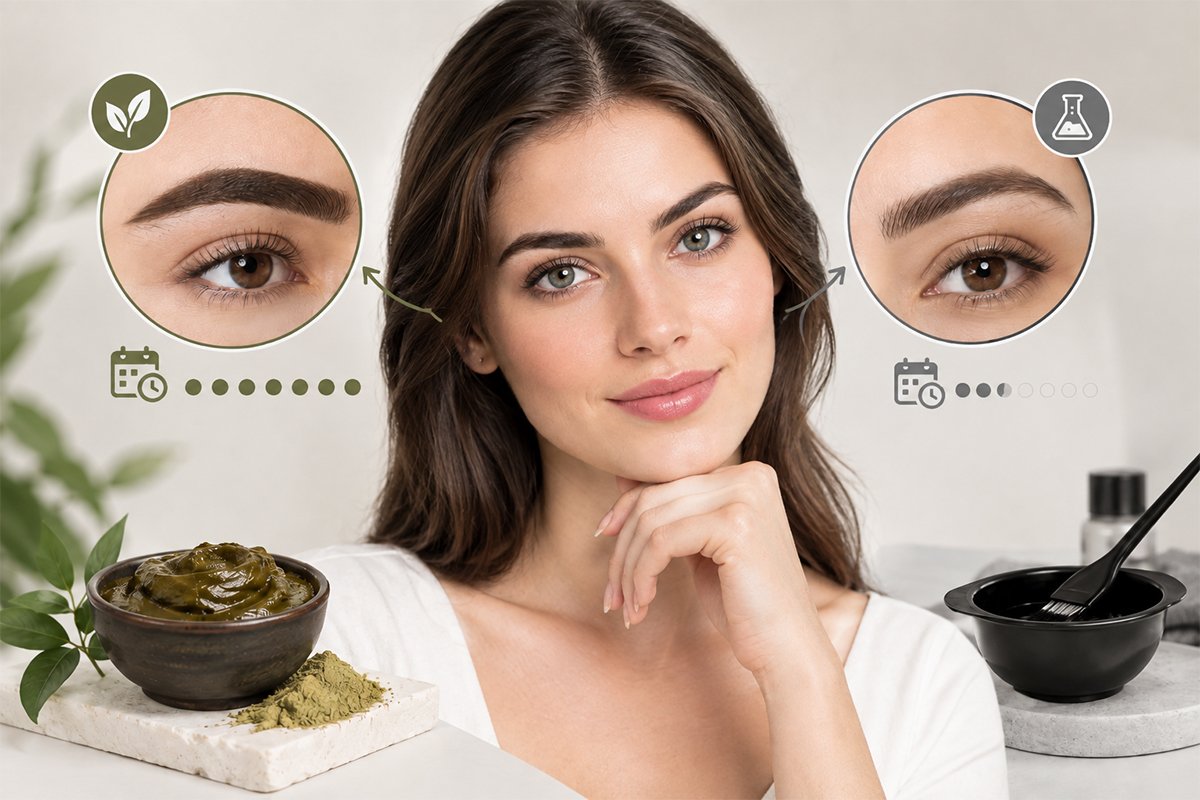
Did you know that some mummies unearthed in Egypt still have flame-red hair, dyed with henna thousands of years ago? The pigment behind that color is lawsone, a molecule in the henna leaf that bonds with protein, and it is especially effective on keratin, the protein hair is made of. On a mummy, that bond is forever, because nothing sheds, regrows, or meets a face cleanser. On a living face, the same pigment runs into oily skin, shedding hairs and a bathroom sink. So how long do henna brows actually last, and does a standard brow tint do any better?
Henna brows usually hold color on the hair for about four to six weeks, but the skin stain beneath fades sooner, in roughly two to ten days. A standard brow tint colors only the hair for around two to six weeks depending on the formula and leaves no lasting skin stain. Salons and eyebrow tint manufacturers quote similar ranges. They are guidelines, not guarantees.
How Long Do Henna Brows Last on Skin and on Hair?
Henna brows means tinting the brows with a paste made from powdered henna leaf. In simple terms, it is a brow tint that also leaves a soft stain on the skin for added definition, which is why it reads as a filled-in brow.
The answer comes in two parts, because hair and skin hold color for different lengths of time:
- On the hair: roughly four to six weeks, fading gradually rather than vanishing overnight.
- On the skin: anywhere from a couple of days to about two weeks. Seven to ten days is the figure most often quoted.
Think of the skin stain as a sticky note: very visible, never meant to stay. The hair color is the filing cabinet: quieter, but it holds on far longer.
Two caveats are worth knowing. First, pure henna leaf gives a brown to reddish-brown result, so other shades, such as black, need additional ingredients. Second, most published longevity figures come from salon and supplier guidance rather than controlled studies, so read them as ranges.
How Long Does a Standard Brow Tint Last?
A standard brow tint means a dye, usually mixed with a developer, that colors the brow hairs only. In simple terms, it darkens the hair without drawing a skin stain beneath it.
Guidance varies. Some salon sources put results at two to four weeks, while some professional formulas are described as lasting up to six weeks. One professional dye is described as tinting hairs for up to six weeks without staining the skin.
The wide gap isn’t a contradiction. Formula strength, processing time, hair type, and aftercare all move the result.
Henna vs Standard Tint vs Hybrid Stain: How Do They Compare?
A third option belongs in the comparison. A hybrid brow stain is a henna-free dye that colors both hair and skin. In simple terms, it tries to give henna’s skin stain at the speed of an ordinary tint. Hybrid stains and brow lamination are both popular in salons right now, and hybrids are often chosen because their henna-free formula can be combined with lamination.
Pulling together typical salon and supplier guidance, hybrids are described as lasting up to about six weeks on hair and seven to ten days on skin.
| Henna brows | Standard brow tint | Hybrid stain | |
| What it colors | Hair and skin | Hair only | Hair and skin |
| Typical hair longevity | About 4–6 weeks | About 2–6 weeks, formula-dependent | Up to about 6 weeks |
| Typical skin-stain longevity | Roughly 2–14 days (7–10 most quoted) | None to negligible | About 7–10 days |
| Shade flexibility | Brown to reddish-brown base; other shades need added ingredients. | Wide dye-based range | Wide dye-based range |
| Application time | Longer, often 15–20 minutes | Shorter | Often around 10 minutes |
On the hair, the three options overlap more than the marketing suggests. The real differences are the skin stain, the shades available, and the handling.
Why Does Brow Color Fade Sooner for Some People?
Two clocks run at once. The skin’s surface renews and is worn down by oil, washing, and friction, so the skin stain goes first. The hairs themselves shed and are replaced, so as brow hairs grow, the dyed hair is gradually replaced by undyed hair. Brows don’t ask permission before shedding.
Several things set the pace:
- Skin type. Oily skin tends to break down the stain faster, while dry skin holds it a little longer.
- Hair density. Very sparse brows give the dye less to grip, so the result may not last as long.
- Formula and technique. Brow-specific, high-quality henna and even skilled application tend to last longer.
- Aftercare. Vigorous scrubbing and prolonged sun exposure can speed fading.
Which Option Suits Which Client?
- Sparse or patchy brows: henna or a hybrid, because the skin stain creates a filled-in look where hair is thin.
- Full brows and a natural finish: a standard tint adds depth to the hair without a stain on the skin.
- Laminated brows: a hybrid is the usual choice, since it is henna-free, whereas brow henna is often said to be a poor match for lamination.
- Very oily skin: set expectations early. The skin stain is likely to be on the shorter end of the range.
What Should You Ask Eyebrow Tint Manufacturers Before Ordering?
Longevity numbers are only as reliable as the product behind them. If you are sourcing eyebrow tint wholesale for a salon, a retail shelf, or your own label, these questions separate a dependable supplier from a hopeful one:
- What exactly is in the jar? Eyebrow henna manufacturers should be able to tell you whether a product is pure henna leaf powder or a blend with other dyes. This matters for color claims and for safety. The FDA notes that the only legal use of PPD, the dye found in many “black henna” products, is as a hair dye, not on the skin.
- How consistent is each batch? A shade that looks different from one order to the next will also last differently. Ask for sample batches and how consistency is checked.
- What does your target market allow? In the US, the FDA states that no color additives are approved for dyeing eyebrows or eyelashes, and its color additive listing for henna covers hair only. Other countries and local licensing rules differ. For example, Oregon’s cosmetology regulator has issued its own guidance treating eyebrow henna as part of hair design practice. Check requirements for your market with a qualified regulatory adviser, and see the FDA’s hair dye guidance. U.S. flag: An official website of the United States government +2, and
- What are the shelf life and packaging formats? Some manufacturers supply henna in pre-measured 10 g pouches with OEM packaging options, which suits single-use salon treatments. Ask how storage and shelf life are handled.
- Do they support private label and bulk orders? Look for clear answers on OEM, private label, bulk supply, and worldwide delivery, plus minimum order quantities. Eyebrow dye suppliers differ widely here, and so does eyebrow color wholesale pricing.
- Are usage and patch-test instructions clear? Processing time and mixing directly affect longevity. The FDA urges consumers to perform patch tests, and your supplier’s instructions should say so too.
How Can You Test Longevity Claims Fairly?
Before committing to a wholesale brow tint order, run a simple in-salon trial. The numbers below are a hypothetical plan, not a result.
- Separate the two questions: how long the hair color lasts and how long the skin stain lasts. lasts and
- Use the same mixing ratio and processing time for every product you compare.
- Test on varied brows: sparse and dense, oily and dry skin.
- Photograph in the same light on day 1, day 7, day 14, and day 28.
- Give every tester the same aftercare instructions, then note who followed them.
If a supplier’s claim survives that, it will survive your customers.
Three Myths About Brow Color Longevity
- “Henna always outlasts tint.” Half true. On the hair, ranges overlap, since some guidance gives henna up to five weeks and a tint two to four, while some professional tints are described as lasting up to six. Henna’s real edge is the skin stain.
- “Natural means no risk.” Not quite. Patch tests still apply, and “black henna” products are a known problem.
- “The skin stain shows how long the brows will last.” The skin stain is the first thing to fade. The hair color usually lasts well beyond it.
FAQ
Q. Do henna brows last longer than brow tint?
A. On the hair, they are often similar. Henna can look longer-lasting because it also stains the skin, though that part fades within days to about two weeks.
Q. How long does the skin stain from henna brows last?
A. Typically two days to two weeks, with seven to ten days the most common estimate.
Q. Why does eyebrow henna fade faster on oily skin?
A.
Oil tends to break the stain down sooner, so oily skin often shows a shorter skin stain than dry skin.
Q. Is eyebrow henna approved everywhere?
A.
No. In the US, the FDA says no color additives are approved for dyeing eyebrows or eyelashes, and its henna listing is for hair. Rules in other markets vary, so check before you sell.
Q. What is the difference between henna and hybrid brow stain?
A.
Henna is made from henna leaves. A hybrid is a henna-free dye designed to stain both hair and skin, often quicker to apply and commonly paired with lamination.
Q. What should I check when choosing eyebrow tint manufacturers?
A.
Ask about ingredients, batch consistency, documentation for your market, packaging and shelf life, private-label options, and patch-test guidance.
Q. Can a small salon order brow tint wholesale?
A.
Often, yes, but minimum order quantities vary by supplier. Ask about order sizes, pouch or bottle formats, and sample options before committing.
Conclusion
Henna brows tend to give about four to six weeks on the hair and a skin stain that fades in a week or two. A standard tint gives a similar span on the hair with no skin stain, and a hybrid sits in between. The difference you notice most is how long the skin stain holds, not how long the hair color does.
For buyers, the better question than “which lasts longer?” is “which product is made well enough to last as promised, and is it allowed where I sell?” If you are comparing suppliers, it helps to see how an eyebrow henna manufacturer presents its shades, packaging, and private-label options. This eyebrow henna range is one place to start.
No responses yet